Introduction
Understanding SC/ST Reservation Rules is essential for anyone preparing for Central or State Government jobs in India. Many candidates know that reservation benefits exist, but confusion often arises regarding eligibility, reservation percentages, age relaxation, fee exemptions, promotions, and document requirements. Missing even one important rule can result in rejection during document verification or loss of valuable benefits.
This comprehensive guide explains SC/ST Reservation Rules in simple language for aspirants appearing in UPSC, SSC, banking, railway, Defence, PSU, State PSC, teaching, and other Government recruitment examinations. Whether you are applying for your first government job or preparing for higher-level competitive examinations, this article will help you understand how reservation policies work, who can claim the benefits, and what mistakes you should avoid while submitting your application.
Why SC/ST Reservation Rules Matter
The primary objective of SC/ST Reservation Rules is to provide equal opportunities in education, public employment, and social development to communities that have historically faced discrimination and social disadvantages.
Reservation is not simply about reserved seats. It also includes several supporting benefits such as:
- Reservation in vacancies
- Age relaxation
- Application fee concessions
- Relaxation in qualifying marks (where applicable)
- Reservation in promotions (for eligible services)
- Special recruitment drives
- Relaxation in experience requirements in certain recruitments
These measures improve representation of Scheduled Castes (SC) and Scheduled Tribes (ST) in Government services across various departments.
Constitutional Basis of SC/ST Reservation Rules
The Constitution of India provides the legal foundation for reservation policies.
Some of the most important constitutional provisions include:
Article 14
Provides equality before law and equal protection of laws.
Article 15(4)
Allows the Government to make special provisions for socially and educationally backward classes, Scheduled Castes, and Scheduled Tribes.
Article 16(4)
Permits reservation in public employment for backward classes that are not adequately represented in Government services.
Article 16(4A)
Allows reservation in promotions for Scheduled Castes and Scheduled Tribes under specified conditions.
Article 46
Directs the State to promote the educational and economic interests of Scheduled Castes and Scheduled Tribes while protecting them from social injustice.
These constitutional provisions collectively form the legal framework behind SC/ST Reservation Rules followed by Central and State Governments.
Who Comes Under SC and ST Categories?
The Government of India publishes official lists of Scheduled Castes and Scheduled Tribes for every State and Union Territory.
A person can claim reservation only if:
- Their caste or tribe appears in the official Presidential Order for their respective State or Union Territory.
- They possess a valid caste certificate issued by the competent authority.
- They satisfy all conditions mentioned in the recruitment notification.
It is important to note that reservation status may differ from one State to another. A caste recognized as Scheduled Caste in one State may not automatically receive the same status elsewhere.
Reservation Percentage in Central Government Jobs – SC/ST Reservation Rules
The reservation percentage under SC/ST Reservation Rules for direct recruitment in central government services is generally as follows:
| Category | Reservation |
|---|---|
| Scheduled Castes (SC) | 15% |
| Scheduled Tribes (ST) | 7.5% |
| OBC (Non-Creamy Layer) | 27% |
| EWS | 10% |
| Unreserved | Remaining vacancies |
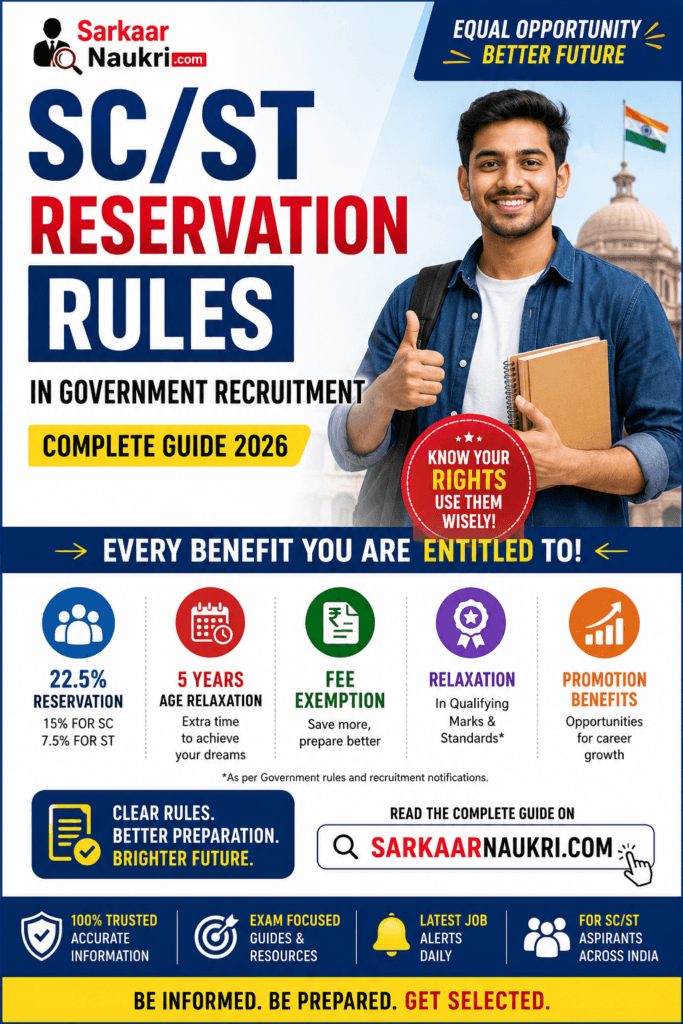
Together, SC and ST candidates receive 22.5% reservation in direct recruitment conducted by most Central Government departments.
However, candidates should always verify the reservation details mentioned in the specific recruitment notification because some organizations may have post-specific reservation rosters.
Where Do SC/ST Reservation Rules Apply?
Reservation benefits are commonly available in:
Central Government Jobs
Examples include:
- UPSC
- SSC
- Railways
- Banking
- Defence Civilian Posts
- Central Universities
- IITs
- NITs
- AIIMS
- ESIC
- DRDO
- ISRO
- PSUs
State Government Jobs
Every State Government follows its own reservation roster based on State laws and local population.
Examples include:
- State Public Service Commissions
- Non Teaching Jobs
- Teaching Jobs
- State Universities
- Central Jobs
- State Jobs
Although the constitutional principles remain the same, percentages and additional benefits may vary.
Types of Benefits Available Under SC/ST Reservation Rules
Many candidates think reservation only means reserved vacancies. In reality, the benefits are much broader.
1. Reservation in Vacancies
A fixed percentage of posts is reserved for SC and ST candidates in eligible recruitments.
2. Age Relaxation
Most Central Government recruitments provide age relaxation for SC/ST applicants.
The relaxation usually extends the maximum age limit, allowing candidates additional years to apply.
3. Fee Exemption
Several recruitment agencies either completely waive or significantly reduce application fees for SC/ST candidates.
Examples include:
- UPSC
- SSC
- Railway Recruitment Boards
- Many State PSCs
4. Relaxation in Selection Standards
Certain recruitments may provide relaxation in qualifying marks, experience requirements, or minimum standards wherever Government rules permit.
This relaxation is always mentioned in the official recruitment notification.
5. Reservation in Promotion
For eligible Government services, SC/ST Reservation Rules may also apply to promotions in accordance with constitutional provisions and applicable Supreme Court judgments.
Difference Between Vertical and Horizontal Reservation
One of the most confusing topics for candidates is the distinction between vertical and horizontal reservation.
Vertical Reservation
Vertical reservation includes:
- SC
- ST
- OBC
- EWS
These categories receive fixed reservation percentages.
Horizontal Reservation
Horizontal reservation cuts across all categories.
Examples include:
- Persons with Benchmark Disabilities (PwBD)
- Ex-Servicemen
- Women (in many State recruitments)
- Sports Persons
For example, an SC candidate may also receive reservation under the PwBD category if eligible.
Age Relaxation Under SC/ST Reservation Rules
One of the most valuable benefits available under SC/ST Reservation Rules is age relaxation. Every year, thousands of candidates become eligible for government jobs solely because of this provision. While the exact relaxation may differ depending on the recruiting authority, most Central Government organizations follow a common pattern.
Age Relaxation in Central Government Recruitment
| Category | Age Relaxation |
|---|---|
| Scheduled Caste (SC) | 5 Years |
| Scheduled Tribe (ST) | 5 Years |
| OBC (Non-Creamy Layer) | 3 Years |
| PwBD (Additional, where applicable) | As per Government rules |
| Ex-Servicemen | As per applicable rules |
For example, if the maximum age limit for a post is 30 years, eligible SC and ST candidates can generally apply up to 35 years, subject to the specific recruitment notification.
Candidates should always read the advertisement carefully because certain organizations may provide additional relaxations based on the nature of the post or service.
Reservation in Direct Recruitment
Most Central Government departments implement SC/ST Reservation Rules during direct recruitment. This means that a fixed percentage of vacancies are reserved exclusively for eligible SC and ST candidates.
The reservation roster is prepared before recruitment begins, ensuring that reserved vacancies are distributed according to Government norms.
Direct recruitment through organizations such as UPSC, SSC, Railway Recruitment Boards, Banking institutions, Central Universities, IITs, AIIMS, ESIC, and many Public Sector Undertakings generally follows these reservation policies.
Candidates applying under the reserved category compete primarily for reserved vacancies. However, if an SC or ST candidate secures marks high enough to qualify on merit without using reservation, they are usually counted against the unreserved category wherever applicable under Government rules. This ensures that reserved vacancies remain available for other eligible candidates.
Reservation in Promotions
Unlike direct recruitment, reservation in promotions has evolved through constitutional amendments and judicial decisions.
Article 16(4A) of the Constitution allows reservation in promotions for Scheduled Castes and Scheduled Tribes under specified conditions. However, its implementation depends upon Government policies and various Supreme Court judgments.
Not every department follows identical promotion rules. Promotion policies may differ based on:
- Cadre strength
- Nature of service
- Departmental rules
- Applicable Government orders
- Judicial directions
Government employees should therefore rely on the promotion rules applicable to their own department rather than assuming uniform implementation across all services.
Application Fee Exemption
Another significant benefit under SC/ST Reservation Rules is exemption or concession in examination fees.
Many Central Government recruitment agencies either completely waive the application fee or charge a reduced fee for eligible SC/ST candidates.
Examples include:
- Staff Selection Commission (SSC)
- Union Public Service Commission (UPSC)
- Railway Recruitment Boards (RRB)
- Many State Public Service Commissions
- Central Universities
- Several Public Sector Undertakings
However, fee exemptions are not universal. Some organizations charge the same fee to all applicants, especially for contractual appointments or autonomous institutions.
Candidates should never assume that fee exemption is automatic. Always verify the application fee section in the official notification before submitting the application.
Relaxation in Qualification and Selection Standards
Many candidates mistakenly believe that SC/ST Reservation Rules automatically reduce educational qualifications. This is incorrect.
Educational qualifications generally remain the same for all candidates unless the recruitment notification specifically mentions otherwise.
In certain recruitments, the recruiting authority may provide relaxation in:
- Minimum qualifying marks
- Experience requirements
- Physical standards
- Skill test qualifying marks
- Interview cut-off
- Suitability standards
Such relaxations are not universal and are permitted only where Government rules allow them. Therefore, candidates should carefully read the eligibility conditions before applying.
Documents Required to Claim Reservation Benefits
Candidates claiming benefits under SC/ST Reservation Rules must produce valid supporting documents during recruitment.
The most commonly required documents include:
- Scheduled Caste or Scheduled Tribe Certificate issued by the competent authority.
- Identity proof.
- Educational qualification certificates.
- Date of Birth proof.
- Category certificate in the prescribed Government format.
- Disability certificate (if claiming PwBD reservation).
- No Objection Certificate (for Government employees, where applicable).
During document verification, recruiting authorities carefully examine whether the caste certificate has been issued by the competent authority and whether it conforms to the prescribed format.
Failure to produce valid documents may lead to cancellation of candidature, even if the candidate has successfully cleared the examination.
Common Misconceptions About SC/ST Reservation Rules
Many rumours circulate among candidates preparing for government jobs. Understanding the facts helps avoid unnecessary confusion.
Myth 1: Every Government Job Offers Reservation
Not all government recruitments provide reservation. Certain contractual, deputation, or project-based appointments may not include reservation benefits.
Myth 2: Educational Qualification Is Always Relaxed
Educational qualifications remain unchanged unless the recruitment notification clearly states otherwise.
Myth 3: Reservation Automatically Guarantees Selection
Reservation provides an opportunity to compete under reserved vacancies, but candidates must still satisfy the prescribed eligibility criteria and perform well in the recruitment process.
Myth 4: Any Caste Certificate Is Accepted Everywhere
The caste certificate must be issued by the competent authority in the prescribed format and should correspond to the State or Union Territory for which reservation is claimed.
Myth 5: Every State Follows the Same Reservation Percentage
Reservation policies differ between Central Government recruitment and various State Governments. Percentages, additional reservations, and eligibility conditions may vary.
Practical Tips for Candidates
If you intend to claim benefits under SC/ST Reservation Rules, following these practical suggestions can help avoid unnecessary complications:
- Obtain your caste certificate well before the application deadline.
- Ensure that your certificate follows the latest prescribed Government format.
- Read the reservation section of every recruitment notification carefully instead of relying on assumptions.
- Check whether age relaxation, fee exemption, or reservation applies to the specific recruitment.
- Preserve both physical and scanned copies of all important documents.
- Verify that your personal details match exactly across educational certificates, identity documents, and caste certificates.
- Do not wait until document verification to identify discrepancies in your records.
- Keep track of Government notifications and updates related to reservation policies, as rules may change over time.
State-wise Variations in SC/ST Reservation Rules
Although the Constitution provides the legal framework for SC/ST Reservation Rules, individual State Governments have the authority to implement reservation policies according to their own legislation and demographic requirements. As a result, reservation percentages, additional benefits, and recruitment procedures may vary from one State to another.
For example:
- Some States provide reservation for local categories in addition to SC/ST reservation.
- Certain States reserve specific posts only for local candidates.
- Age relaxation and horizontal reservation policies may differ from Central Government recruitment.
- Recruitment through State Public Service Commissions follows the respective State Government’s reservation roster.
Therefore, candidates should always read the recruitment notification carefully instead of assuming that Central Government reservation rules automatically apply to every State recruitment.
Important Government Guidelines Every Candidate Should Know
Candidates claiming benefits under SC/ST Reservation Rules should remember the following points:
Reservation Is Notification-Specific
Every recruitment advertisement clearly specifies whether reservation applies, the percentage of reserved vacancies, age relaxation, fee exemption, and document requirements.
Valid Caste Certificate Is Mandatory
Candidates must possess a caste certificate issued by the competent authority in the prescribed format. Incorrect or outdated certificates may lead to cancellation of candidature.
Reservation Cannot Be Claimed Without Supporting Documents
Recruiting authorities verify all reservation-related documents during document verification. Failure to produce valid certificates may result in disqualification even after qualifying the examination.
Merit Candidates Are Treated Separately
An SC or ST candidate selected on open merit without availing reservation benefits is generally counted against the unreserved category wherever applicable under Government rules. This helps preserve reserved vacancies for other eligible candidates.
Reservation Policies May Change
Government recruitment policies are periodically updated through notifications, amendments, and judicial decisions. Candidates should always rely on the latest official notification instead of old information available on social media or unofficial websites.
Frequently Asked Questions
1. How much reservation is available for SC and ST candidates in Central Government jobs?
Under normal Central Government recruitment, Scheduled Castes receive 15% reservation, while Scheduled Tribes receive 7.5% reservation, making a combined reservation of 22.5%.
2. Do SC/ST candidates always receive a five-year age relaxation?
Most Central Government recruitments provide five years’ age relaxation for eligible SC and ST candidates. However, applicants should always verify the age relaxation mentioned in the respective recruitment notification.
3. Is the application fee waived for SC/ST candidates?
Many recruitment agencies such as UPSC, SSC, and Railway Recruitment Boards provide fee exemption or concession for eligible SC/ST candidates. However, this benefit depends on the recruitment notification and is not available in every recruitment.
4. Can an SC candidate compete for General category vacancies?
Yes. If an SC candidate secures marks high enough to qualify on merit without using reservation benefits, they may be selected against an unreserved vacancy wherever applicable under Government rules.
5. Do SC/ST Reservation Rules apply to every Government recruitment?
No. While reservation is available in most regular Government recruitments, certain contractual, deputation, project-based, or temporary appointments may not provide reservation benefits. Candidates should always check the official notification.
6. Can reservation benefits be claimed without a caste certificate?
No. A valid caste certificate issued by the competent authority is mandatory for claiming reservation benefits. Failure to produce the required certificate during document verification may result in cancellation of candidature.
7. Are SC/ST Reservation Rules the same in every State?
No. Although the constitutional principles remain the same, individual States may have different reservation percentages, local reservation policies, age relaxation rules, and recruitment procedures.
8. What is the biggest mistake candidates make while claiming reservation?
The most common mistake is assuming that reservation benefits are automatic. Candidates should carefully read the recruitment notification, submit the correct caste certificate, verify eligibility, and ensure all supporting documents are accurate before applying.
Conclusion
Understanding SC/ST Reservation Rules is essential for every aspirant preparing for Central or State Government jobs. Reservation is not limited to reserved vacancies—it also includes important benefits such as age relaxation, fee concessions, promotion policies, and other recruitment relaxations wherever applicable. However, candidates must always rely on the specific recruitment notification because reservation provisions can vary across organizations and States. By staying informed, maintaining valid documents, and following the prescribed guidelines, applicants can fully utilize the benefits available under SC/ST Reservation Rules while avoiding common mistakes during the recruitment process.
Related Articles You May Like
- Latest Government Jobs – Explore the newest Central and State Government recruitment notifications across India.
- State Government Jobs – Check the latest vacancies released by State Public Service Commissions and State Government departments.
