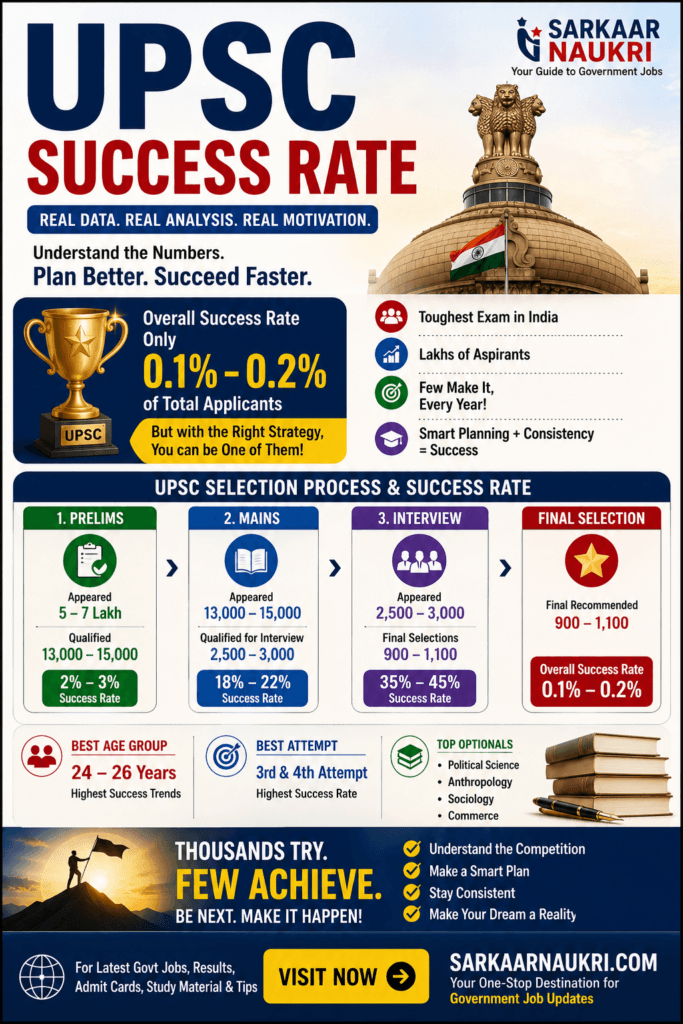
The UPSC success rate remains one of the most discussed topics among civil services aspirants because the examination is widely regarded as one of the toughest competitive exams in India. Every year, lakhs of candidates apply for the UPSC Civil Services Examination, but only a very small percentage ultimately secure positions such as IAS, IPS, IFS, and IRS officers.
Understanding the UPSC success rate is important because it helps aspirants set realistic expectations and build a long-term preparation strategy. Many candidates are intimidated after hearing that only around 0.1%–0.2% of applicants eventually make it to the final merit list. However, the raw numbers tell only part of the story. The actual competition is different when analyzed stage by stage. Aspirants who understand selection ratios, attempt patterns, age trends, and preparation cycles can approach the examination more strategically.
Related Articles:
- https://sarkaarnaukri.com/category/latest-jobs/
- https://sarkaarnaukri.com/category/graduate-jobs/
- https://sarkaarnaukri.com/category/results/
What is the UPSC Success Rate?
The UPSC Success Rate refers to the percentage of candidates who successfully clear all stages of the Civil Services Examination and receive final recommendations from the Union Public Service Commission.
The examination consists of:
- Preliminary Examination
- Main Examination
- Personality Test (Interview)
Candidates must clear each stage before progressing to the next level.
Official UPSC Website:
According to recent UPSC-related statistics, the overall final selection ratio generally remains around 0.1%–0.2% when compared with total applicants.
How Many Candidates Apply for UPSC Every Year?
The Civil Services Examination attracts one of the largest applicant pools in India.
Recent estimates show:
| Stage | Approximate Numbers |
|---|---|
| Total Applications | 12–14 Lakh |
| Candidates Appearing in Prelims | 5–7 Lakh |
| Candidates Qualifying for Mains | 13,000–15,000 |
| Candidates Reaching Interview | 2,500–3,000 |
| Final Recommendations | 900–1,100 |
Recent UPSC-related data indicates that more than 13 lakh candidates applied for UPSC 2024, while approximately 14,627 candidates qualified for the Mains examination.
This means that most applicants are eliminated during the Preliminary stage itself.
UPSC Success Rate Stage-Wise Analysis
Preliminary Examination Success Rate
The Preliminary Examination acts as the first filtering stage.
Approximate numbers:
- Candidates Appearing: 5–7 lakh
- Candidates Qualifying: 13,000–15,000
This means only around 2%–3% of serious candidates typically clear Prelims.
Main Examination Success Rate
The Mains stage is considered the most demanding part of the examination process.
Typical numbers:
- Candidates Appearing: 13,000–15,000
- Candidates Qualifying for Interview: 2,500–3,000
The conversion rate usually remains around 18%–22%.
Interview Success Rate
The Personality Test is the final stage.
Typical numbers:
- Candidates Appearing: 2,500–3,000
- Final Recommendations: 900–1,100
The success rate during the interview stage often ranges between 35% and 45%.
UPSC Success Rate: Why Raw Numbers Can Be Misleading
Many aspirants become discouraged after hearing that the UPSC Success Rate is only around 0.1%.
However, there is an important reality:
A large percentage of registered candidates:
- Do not appear for the exam.
- Appear without preparation.
- Give casual attempts.
The actual competition is among serious aspirants who consistently prepare for at least one to two years.
This means the effective competition is significantly smaller than the headline application numbers suggest.
Best Age for UPSC Success
Recent UPSC-related analysis indicates that the highest success rates are often observed among candidates in the 24–26 age group.
Why does this age group perform well?
Better Preparation Time
Most candidates have completed graduation and can focus more seriously on preparation.
Maturity and Decision Making
Candidates in this age range usually develop stronger answer-writing skills and analytical abilities.
Multiple Attempts Available
They still retain sufficient attempts if the first few attempts are unsuccessful.
Which Attempt Has the Highest UPSC Success Rate?
One common misconception is that toppers mostly clear UPSC in their first attempt.
Data-based analyses suggest otherwise.
The highest number of successful candidates are often found among aspirants appearing in their third or fourth attempt.
Reasons include:
- Better understanding of the syllabus.
- Improved answer-writing skills.
- Greater familiarity with exam trends.
- Stronger interview performance.
Persistence plays a major role in UPSC success.
Educational Background and UPSC Success Rate
Another common question is whether a particular educational stream offers an advantage.
Recent analyses indicate that candidates from Science and Engineering backgrounds form a large percentage of successful candidates.
However, this does not mean humanities students are at a disadvantage.
Success depends more on:
- Preparation quality
- Optional subject selection
- Revision strategy
- Answer writing practice
Many top rankers come from diverse academic backgrounds.
Optional Subjects and Success Rate
Optional subjects continue to influence final rankings significantly.
Several analyses indicate that subjects such as:
- Political Science
- Anthropology
- Sociology
- Commerce
often show competitive success rates.
However, aspirants should not choose an optional solely based on success rate statistics.
Important factors include:
- Personal interest
- Availability of study material
- Guidance support
- Previous academic background
Why Most Candidates Fail UPSC
Understanding failure patterns is equally important in UPSC Success Rate Analysis.
Lack of Revision
Many candidates focus excessively on collecting resources.
Without revision, retention declines significantly.
Ignoring Previous Year Questions
UPSC frequently repeats themes and concepts.
Previous Year Questions help identify patterns.
Weak Answer Writing
Mains requires structured and analytical answers.
Knowledge alone is not sufficient.
Neglecting CSAT
Several candidates fail because they underestimate the qualifying CSAT paper.
Poor Time Management
Covering the syllabus without proper planning often results in incomplete preparation.
How to Improve Your Chances of Success
Build Strong Fundamentals
Start with NCERT books and standard reference sources.
Focus on Current Affairs
Current affairs remain critical across all stages.
Useful Sources:
Practice Answer Writing
Consistent answer writing improves articulation and speed.
Attempt Mock Tests
Mock tests improve:
- Accuracy
- Time management
- Exam temperament
Maintain Consistency
UPSC rewards sustained effort more than short bursts of preparation.
What UPSC Success Rate Really Teaches Aspirants
The biggest lesson from UPSC Success Rate Analysis is that success depends less on intelligence and more on consistency.
Many selected candidates:
- Failed previous attempts.
- Changed strategies.
- Improved answer writing.
- Learned from mistakes.
The examination rewards persistence, adaptability, and disciplined preparation.
Frequently Asked Questions
What is the overall UPSC Success Rate?
The overall final selection ratio generally remains around 0.1%–0.2% of total applicants.
How many candidates clear UPSC Prelims?
Usually around 13,000–15,000 candidates qualify for Mains from several lakh candidates appearing in Prelims.
Which attempt has the highest UPSC success rate?
Studies based on UPSC-related reports suggest that third and fourth attempts often produce the highest number of successful candidates.
What is the best age to crack UPSC?
The 24–26 age group frequently shows strong success trends in UPSC selections.
Does educational background matter in UPSC?
Educational background can influence preparation style, but success ultimately depends on preparation quality and consistency.
Conclusion
UPSC Success Rate Analysis shows that the Civil Services Examination is undoubtedly competitive, but the numbers should not discourage serious aspirants. While lakhs of candidates apply every year, the actual competition narrows significantly at each stage. Candidates who focus on strong fundamentals, consistent revision, answer writing practice, and long-term preparation strategies substantially improve their chances of success. Rather than fearing the statistics, aspirants should use them to understand the examination better and prepare more intelligently.
Explore More:
