Every year, lakhs of aspirants from Madhya Pradesh dream of becoming a Deputy Collector, DSP, or State Tax Officer, but very few actually understand how the selection process works before they start preparing. If you are one of them, this MPPSC Exam Guide 2026 is meant to clear that confusion right at the start. The Madhya Pradesh Public Service Commission conducts one of the most respected state-level exams in the country, and getting the basics right, eligibility, exam pattern, syllabus, and selection stages, is the first real step toward cracking it. This guide walks you through every part of the process in plain language, so you know exactly what you are preparing for and why each stage matters.
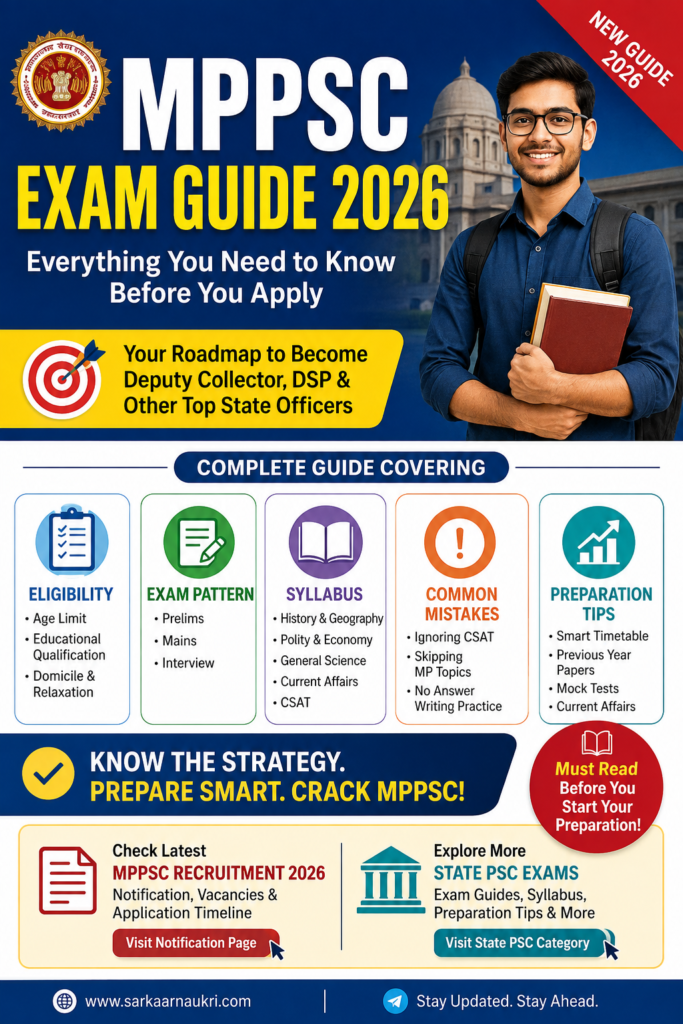
Why This MPPSC Exam Guide 2026 Matters
Before diving into books and coaching material, most aspirants waste months because they don’t fully understand the exam structure. A proper MPPSC Exam Guide 2026 saves that time by laying out the eligibility rules, the three stages of the exam, the syllabus weightage, and the common traps that trip up first-time candidates. MPPSC recruits for over 50 posts under the State Civil Services and State Forest Service exams combined, including Deputy Collector, Deputy Superintendent of Police, District Registrar, Assistant Director, and various Class 1 and Class 2 posts. Because the competition is intense and the syllabus is vast, aspirants who understand the exam framework early tend to plan their preparation far more efficiently than those who jump straight into random study material.
MPPSC Eligibility Criteria
Every MPPSC Exam Guide 2026 has to start with eligibility, since a large number of applications get rejected simply because candidates did not check the basic conditions.
- Nationality: Candidates must be Indian citizens.
- Age Limit: The general age limit is typically 21 to 40 years as on 1 January of the exam year, though this can shift slightly depending on the notification.
- Age Relaxation: SC, ST, and OBC candidates from Madhya Pradesh get age relaxation as per state rules, and there are additional relaxations for female candidates, PwD candidates, and Ex-servicemen.
- Educational Qualification: A bachelor’s degree from a recognized university is the minimum requirement for most posts, though a few technical or specialized posts may ask for specific degrees.
- Domicile: Most posts are open to candidates from Madhya Pradesh, with certain relaxations and reservations tied to state domicile rules.
Since eligibility conditions can vary slightly between the State Service Exam and the State Forest Service Exam, it is worth cross-checking the latest official notification for the specific post you are targeting rather than relying only on this MPPSC Exam Guide 2026 or last year’s rules.
MPPSC Exam Guide 2026 Pattern: Three Stages Explained
The MPPSC selection process runs in three stages, and each one filters candidates differently.
Stage 1: Preliminary Exam This is an objective-type screening exam with two papers, General Studies and General Aptitude (CSAT), each carrying 200 marks. The CSAT paper is qualifying in nature, meaning candidates only need to clear a minimum threshold, while the General Studies score decides who moves to the Mains.
Stage 2: Main Exam The Main exam is descriptive and considerably tougher. It typically includes multiple General Studies papers along with a language paper, testing depth of knowledge rather than just recall. This stage carries the highest weightage in the final merit and demands strong answer-writing practice, not just content knowledge.
Stage 3: Interview (Personality Test) Candidates who clear the Main exam are called for an interview that evaluates communication skills, general awareness, decision-making ability, and suitability for administrative roles. The interview marks are added to the Main exam score to prepare the final merit list.
MPPSC Syllabus Overview
The syllabus for this MPPSC Exam Guide 2026 covers a wide range of static and dynamic topics, and understanding the weightage helps prioritize study time.
- History: Ancient, Medieval, and Modern Indian History, with special focus on Madhya Pradesh’s regional history and freedom movement contributions.
- Geography: Indian and Madhya Pradesh geography, including physical features, resources, and economic geography.
- Polity: Indian Constitution, governance structures, panchayati raj, and public administration.
- Economy: National and Madhya Pradesh state economy, budget, five-year plans, and government schemes.
- General Science: Basic science concepts along with current developments in science and technology.
- Current Affairs: National and state-level events, government policies, and MP-specific developments form a significant chunk of both Prelims and Mains.
- CSAT: Comprehension, logical reasoning, and basic numeracy for the qualifying paper.
Madhya Pradesh-specific content carries noticeably more weightage in MPPSC compared to other state exams, so candidates preparing only from generic UPSC-style material often underperform unless they add dedicated MP-focused reading.
Common Mistakes and Misconceptions
Many aspirants approach this exam with assumptions that end up costing them a full attempt.
- Assuming Prelims marks count toward the final result: They don’t. Prelims is purely qualifying for most candidates, and only the Mains and Interview scores build the final merit.
- Ignoring the CSAT paper: Because CSAT is qualifying, candidates often underprepare for it and end up disqualified despite scoring well in General Studies.
- Underestimating MP-specific topics: Treating MPPSC like a smaller UPSC exam and skipping state-specific history, geography, and current affairs is one of the most common reasons for low Prelims scores.
- Starting Mains preparation too late: Since Mains is descriptive and answer-writing heavy, candidates who begin practicing only after the Prelims result struggle to build speed and structure in time.
- Relying on a single source: MPPSC syllabus is broad enough that depending on just one book or one coaching module usually leaves gaps, especially in current affairs and MP-specific content.
Practical Tips for MPPSC Preparation
- Build a subject-wise timetable that gives extra weightage to Madhya Pradesh history, geography, and current affairs, since these topics are unique to this exam.
- Practice previous years’ MPPSC papers to understand the exact difficulty level and question pattern rather than relying only on generic state PSC material.
- Start answer writing practice for Mains well before the Prelims result is out, since descriptive writing speed takes months to build.
- Dedicate a fixed daily slot to current affairs, focusing especially on Madhya Pradesh government schemes, budget announcements, and state-level appointments.
- Take regular mock tests for both Prelims and Mains to track improvement and identify weak areas early rather than close to the exam date.
Frequently Asked Questions – MPPSC Exam Guide 2026
1. What is the age limit for MPPSC Exam Guide 2026? The general age limit is usually 21 to 40 years as on 1 January of the exam year, with relaxation for reserved categories as per Madhya Pradesh government rules.
2. Is the MPPSC Prelims exam qualifying in nature? Yes, the Prelims exam, including both the General Studies and CSAT papers, is qualifying, and only the Mains and Interview marks count toward the final merit list.
3. How many stages are there in the MPPSC selection process? There are three stages: Preliminary Exam, Main Exam, and Interview (Personality Test).
4. Do I need a specific degree to be eligible for the MPPSC Exam Guide 2026? No, a bachelor’s degree in any discipline from a recognised university is generally sufficient for most posts, though a few technical posts may need a specific qualification.
5. How much weightage does Madhya Pradesh-specific content carry in the syllabus? A significant portion of both Prelims and Mains, particularly in History, Geography, and Current Affairs, focuses specifically on Madhya Pradesh rather than only national-level content.
6. Can candidates from outside Madhya Pradesh apply for MPPSC? Most posts require Madhya Pradesh domicile, though the exact domicile and reservation rules should always be checked in the latest official notification since they can vary by post.
7. What is the best way to start preparing for the MPPSC Exam Guide 2026? Begin by understanding the exam pattern and syllabus thoroughly, as covered in this MPPSC Exam Guide 2026, then build a timetable that balances static subjects, current affairs, and regular answer writing practice.
Conclusion—MPPSC Exam Guide 2026
This MPPSC Exam Guide 2026 covers the eligibility rules, three-stage exam pattern, syllabus weightage, and preparation tips that every serious aspirant should know before starting their preparation. Understanding these fundamentals early helps you avoid the common mistakes that cost other candidates a full attempt, especially around Prelims qualifying rules and Madhya Pradesh-specific content. For post-wise vacancy details and the latest application timeline, check our [MPPSC Recruitment 2026 notification page], and for broader exam-wise preparation strategies, visit our State PSC Exams category, PSC Jobs
