Introduction
Every year, lakhs of aspiring teachers sit down to prepare for the Central Teacher Eligibility Test, but a surprising number of them lose valuable marks simply because they never studied the CTET exam pattern closely enough. They know the syllabus, they solve mock tests, yet they walk into the exam hall unsure of how many questions carry how many marks or whether there is negative marking. This confusion costs candidates time and confidence on exam day, and it is entirely avoidable. Understanding the CTET exam pattern is not an optional first step—it is the foundation on which your entire preparation strategy should be built. In this guide, we break down the CTET exam pattern for both Paper 1 and Paper 2 in complete detail, covering subject-wise weightage, marking scheme, duration, and the practical mistakes candidates repeatedly make while ignoring this structure.
Why Understanding the Exam Structure Matters
Before you open a single textbook, it helps to internalize the CTET exam pattern because it tells you exactly where to invest your study hours. This structure is designed by CBSE to test a candidate’s teaching aptitude, subject knowledge, and pedagogical understanding rather than rote memorization. Once you know the CTET exam pattern in detail, you can allocate more revision time to high-weightage sections like Child Development and Pedagogy, instead of spreading your effort evenly across every topic. Many toppers credit their success not to studying more, but to studying smarter, and that smarter approach begins with a clear grasp of how the paper is actually structured. It also helps to remember that this framework has stayed largely consistent over the years, so time spent understanding it now pays off across multiple attempts if needed.
CTET Exam Pattern: Paper 1 (Classes 1 to 5)
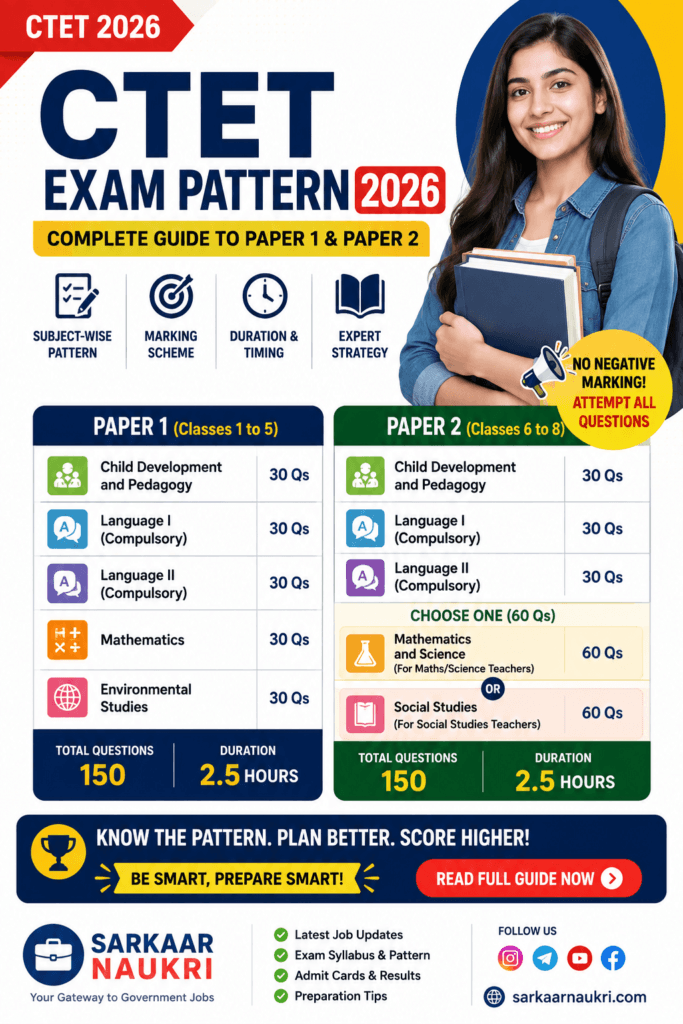
Paper 1 of the CTET exam pattern is meant for candidates who wish to teach primary classes, from Class 1 to Class 5. It consists of 150 multiple-choice questions, each carrying one mark, making the paper worth a total of 150 marks. Candidates get two and a half hours to complete this section. Under the current structure, Paper 1 is divided into five sections:
- Child Development and Pedagogy — 30 questions
- Language I (compulsory) — 30 questions
- Language II (compulsory) — 30 questions
- Mathematics — 30 questions
- Environmental Studies—30 questions
Each section in this part of the CTET exam pattern is compulsory, meaning candidates cannot choose to skip any subject. This structure ensures that a primary school teacher is tested on both subject knowledge and the pedagogical skill required to teach young children effectively. Candidates often ask whether any section can be attempted optionally in Paper 1, and the answer is no—every section must be attempted since all 150 questions contribute to the final score.
CTET Exam Pattern: Paper 2 (Classes 6 to 8)
Paper 2 under the CTET exam pattern is meant for candidates aiming to teach upper primary classes, Classes 6 to 8. Like Paper 1, it also has 150 objective-type questions worth one mark each, to be completed within two and a half hours. However, the subject-wise structure of Paper 2 differs based on the candidate’s chosen specialization:
- Child Development and Pedagogy — 30 questions (compulsory)
- Language I (compulsory) — 30 questions
- Language II (compulsory) — 30 questions
- Mathematics and Science (for Maths/Science teachers) OR Social Studies (for Social Studies teachers)—60 questions
This branching structure is one of the more confusing parts of the CTET exam pattern for first-time candidates, so it is worth repeating: a candidate applying for a Maths/Science teaching post attempts the Mathematics and Science section, while a candidate applying for a Social Studies post attempts the Social Studies section instead. Candidates who are unsure which post they will eventually apply for sometimes prepare both optional sections, which is a safe but time-consuming choice.
Marking Scheme Under the CTET Exam Pattern
A crucial detail that many candidates overlook is the marking scheme built into the CTET exam pattern. Each correct answer earns one mark, and there is no negative marking for incorrect answers. This is genuinely good news, because it means candidates should attempt every single question rather than leaving any blank, since there is nothing to lose by guessing. Knowing this aspect of the exam structure in advance can meaningfully change your exam-day strategy—instead of playing it safe on uncertain questions, you can mark an answer based on elimination and educated guesswork without fear of losing marks. There is also no sectional cutoff within a paper; only the overall percentage across all sections determines whether a candidate qualifies.
Duration and Timing Considerations
The CTET exam pattern allots two and a half hours (150 minutes) for both Paper 1 and Paper 2, which works out to exactly one minute per question. While that sounds tight, most questions are conceptual rather than calculation-heavy, so candidates who have revised well typically finish with time to spare. Time management practice through mock tests, based on the actual exam structure, is one of the most effective ways to build the speed needed on exam day. A useful habit is to attempt the sections you find easiest first so that you bank marks early and approach the harder sections with the remaining time and a calmer mind.
Common Mistakes and Misconceptions
- Ignoring the pattern until the last month: Many candidates start solving mock tests without first mapping them against the CTET exam pattern, which means they don’t realize which sections need more attention until it’s too late.
- Assuming both languages carry equal difficulty: Language I and Language II sections test different skills, and candidates often prepare only one seriously.
- Skipping questions out of habit: Since there is no negative marking, leaving a question blank under this structure is a wasted opportunity—always attempt every question.
- Confusing Paper 2 subject choices: Candidates sometimes forget to prepare the correct optional subject (Maths/Science or Social Studies) matching their intended teaching post.
- Underestimating Child Development and Pedagogy: This section is scoring for candidates who read the concepts carefully, yet many treat it as a formality.
- Treating both papers identically: Paper 1 and Paper 2 test different age-group pedagogy, and candidates who blur the two often lose marks in the pedagogy-based questions.
Practical Tips to Prepare Using the CTET Exam Pattern
- Print or write out the section-wise breakdown of the CTET exam pattern and paste it somewhere visible while you study, so you always study with the weightage in mind.
- Attempt full-length mock tests that mirror the actual exam structure in timing and question distribution, not random topic-wise quizzes alone.
- Focus extra hours on Child Development and Pedagogy and Environmental Studies or Social Studies, since these sections reward conceptual clarity over rote learning.
- Revise previous years’ question papers to see how the CTET exam pattern has been applied in real exams, which helps you spot recurring question styles.
- Since there’s no negative marking, practice answering every question in mock tests within the time limit, rather than skipping the ones you find difficult.
- Keep a small revision notebook mapped to each section of the pattern, so that in the final week before the exam you can revise the entire syllabus quickly without opening every textbook again.
Frequently Asked Questions
1. What is the exam structure for Paper 1? Paper 1 has 150 objective-type questions across five compulsory sections—Child Development and Pedagogy, Language I, Language II, Mathematics, and Environmental Studies—to be completed in two and a half hours.
2. Is there negative marking in this exam? No, this structure does not include negative marking, so candidates are encouraged to attempt every question.
3. Can a candidate appear for both Paper 1 and Paper 2 in one attempt? Yes, candidates who wish to teach both primary and upper primary classes can appear for both papers on the same day, since the CTET exam pattern schedules them in separate sessions.
4. How many questions are there in CTET Paper 2? Paper 2 also has 150 questions, split between compulsory sections and an optional subject section based on the candidate’s chosen specialization.
5. What is the passing mark under the CTET exam pattern? General category candidates generally need 60% to qualify, while relaxed passing percentages apply to reserved categories as per official notifications.
6. How long is the CTET exam? Each paper under this structure runs for two and a half hours (150 minutes), regardless of whether you’re attempting Paper 1 or Paper 2.
7. Which subject should Social Studies teachers focus on in Paper 2? Candidates applying for Social Studies teaching posts should prepare the Social Studies section instead of Mathematics and Science, as defined in the optional part of the exam structure.
8. Does the CTET exam pattern change every year? The overall structure has remained fairly stable over recent cycles, though candidates should always confirm the latest official notification before beginning preparation, since minor updates are occasionally introduced.
Conclusion
Getting comfortable with the CTET exam pattern early in your preparation journey saves you from last-minute panic and helps you build a study plan around what the exam actually rewards. Once the structure, marking scheme, and timing are second nature, your focus can shift entirely to mastering the subject matter itself. For more exam-specific guidance, check out our detailed CTET Syllabus guide and our collection of the latest teaching job notifications to stay updated on upcoming vacancies.
