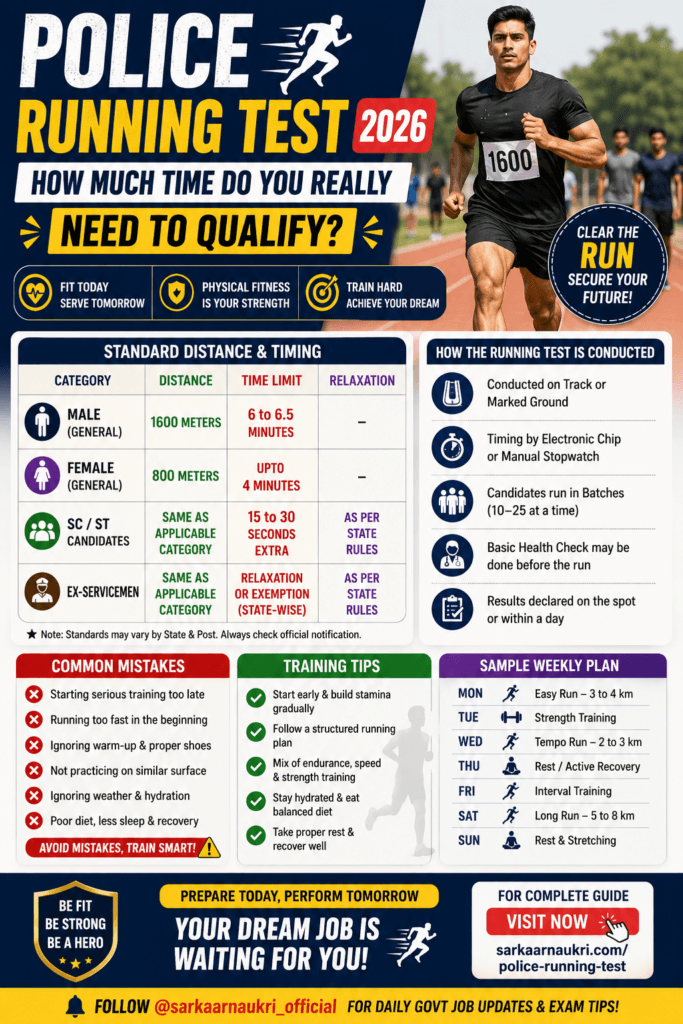
Ask any police recruitment aspirant what worries them most, and a surprising number will say the running test, not the written exam. The police running test is the backbone of the Physical Endurance Test (PET) stage in almost every state and central police recruitment, and unlike the written exam, there’s no partial credit here; you either finish within the prescribed time or you don’t qualify. What makes the police running test particularly tricky is that the distance and timing standards shift depending on your state, category, gender, and sometimes even your age bracket, so a benchmark that applies to one candidate may not apply to another appearing for the same post. This guide breaks down exactly what the police running test involves, how the standards vary, and what a realistic training plan looks like for candidates who are serious about qualifying comfortably rather than just scraping through.
Why the Police Running Test Matters So Much
The police running test exists because cardiovascular endurance is considered a core requirement for police duty, whether it’s chasing a suspect on foot, standing for hours during crowd control, or responding quickly during an emergency. Recruitment boards treat the police running test as a qualifying round, meaning your written exam marks don’t carry forward if you fail to complete the run within the required time, regardless of how strong your score was. In most state police recruitments, the police running test comes right after the written examination and before the police medical test, effectively acting as a gatekeeper stage. Because it’s purely qualifying rather than merit-based in most states, the goal isn’t to be the fastest, it’s simply to finish within the cutoff time, which changes the entire approach candidates should take to preparing for it.
Standard Distance and Timing by Category
The distance and timing requirements for the police running test vary considerably depending on the recruiting state, but some patterns are common across most recruitments.
- Male candidates (General category): Most state police recruitments require a 1600 meter run to be completed in 6 to 6.5 minutes, though some states use a 4800 meter or 5 km run with a longer time window, particularly for constable-level posts.
- Female candidates: The police running test for female candidates typically involves an 800 meter run, with a common time standard of around 4 minutes, though some states extend this to 1600 meters with a proportionally longer window.
- SC/ST/OBC relaxation: Many states provide a relaxed time window, commonly an additional 15 to 30 seconds, for SC and ST candidates in the police running test, with a smaller relaxation sometimes extended to OBC candidates.
- Ex-servicemen candidates: Ex-servicemen are frequently given either a relaxed timing standard or, in several states, complete exemption from the police running test altogether, since their prior service already demonstrates physical fitness.
- Age-based variation: For posts with a wider age eligibility window, some states apply a sliding scale, where candidates in higher age brackets get a slightly longer time to complete the same distance.
Because these numbers differ so much between states, and even between different posts within the same state (constable versus sub-inspector, for example), checking the specific timing in your target recruitment’s official notification is far more reliable than assuming a standard figure applies.
How the Police Running Test Is Actually Conducted
Understanding the logistics of the police running test itself can help reduce first-time nervousness considerably.
- Track and surface: Most recruitments conduct the police running test on a standard track, though some rural or smaller recruitment centers use marked open grounds instead, which can affect surface consistency and pacing.
- Timing method: Electronic timing chips are increasingly common in larger state recruitments, though many boards still rely on manual stopwatch timing with multiple officials cross-checking results.
- Grouping: Candidates typically run in batches of 10 to 25, grouped by category and gender, rather than individually, which means pacing off other runners in your batch is a realistic part of the experience.
- Medical readiness check: Some recruitment boards conduct a basic health check or ask candidates to sign a fitness declaration immediately before the police running test, particularly after past incidents of health emergencies during PET rounds.
- Immediate result declaration: Unlike the written exam, results for the police running test are usually declared on the spot or within a day, and candidates who don’t clear the cutoff are informed immediately rather than waiting weeks.
Common Mistakes and Misconceptions
- Training only in the final month: A large number of candidates start serious running practice only a few weeks before the police running test, which isn’t enough time to build the cardiovascular base needed to comfortably beat the cutoff, especially for candidates without a running background.
- Sprinting too early in the run: Many candidates go out too fast in the first 400 meters and then struggle badly in the final stretch, when a more even pace across the full distance almost always produces a better and more consistent finishing time.
- Ignoring surface and shoe practice: Candidates who train exclusively on treadmills or soft tracks sometimes struggle when the actual police running test is conducted on a harder or unfamiliar surface, so practicing on similar terrain matters.
- Not accounting for weather and time of day: Police running tests are frequently held in the early morning, but sometimes in hot afternoon conditions depending on the recruitment schedule, and candidates who haven’t trained under similar conditions can be caught off guard.
- Assuming relaxation applies automatically: Category-based timing relaxation in the police running test isn’t always automatic; some recruitment boards require candidates to specifically claim it with the correct certificate, so it’s worth confirming this in the notification rather than assuming it.
Practical Training Tips to Prepare
- Build a base with steady-state running first. Spend the first few weeks simply running at a comfortable pace for increasing durations before introducing speed work, since endurance capacity needs to be built gradually rather than rushed.
- Introduce interval training once you have a base. Once you can comfortably run continuously for 20 to 25 minutes, start adding interval sessions, such as repeated 400-meter efforts at your target race pace, with short recovery jogs in between.
- Practice at your actual required distance regularly. If your police running test requires 1600 meters, do timed 1600-meter runs at least once a week in the lead-up so you know exactly what pace you need to hold rather than guessing on the day.
- Train on a similar surface to the test venue. If possible, practice on a track or ground similar to where your police running test will be conducted, since surface familiarity affects both pacing and injury risk.
- Don’t neglect strength and mobility work. Basic leg strength training and stretching reduce injury risk during intense running preparation and often improve running economy, which directly helps your finishing time.
- Simulate test-day conditions occasionally. Run at the same time of day the actual test is likely to be conducted, and if possible, in similar weather, so your body isn’t adjusting to unfamiliar conditions on the actual test day.
Frequently Asked Questions
Q1. How much time do I get to complete the police running test?
It depends heavily on the state, category, and post, but common benchmarks are around 6 to 6.5 minutes for a 1600-meter run for general category male candidates, with relaxed timing for reserved categories and female candidates.
Q2. Is the police running test the same for constable and sub-inspector posts?
No, distance and timing standards often differ between posts within the same state, so it’s important to check the specific notification for your target post rather than assuming constable-level standards apply to officer-rank recruitment.
Q3. Can I retake the police running test if I fail on my first attempt?
Generally no, the police running test is conducted once per recruitment cycle, and failing to meet the timing cutoff usually results in disqualification from that cycle, though rules can vary slightly by board.
Q4. Do ex-servicemen get exemption from the police running test?
In many states, yes, ex-servicemen either receive a relaxed timing standard or are exempted entirely from the police running test, though this varies by state and should be confirmed in the specific recruitment notification.
Q5. How many weeks of training are enough to qualify for the police running test?
For candidates starting from a low fitness base, 8 to 12 weeks of structured training is generally a more realistic timeline than the 2 to 3 weeks many candidates attempt, since cardiovascular endurance takes time to build safely.
Q6. What happens if I feel unwell during the police running test?
Most recruitment boards have medical staff present and will stop the test for a candidate showing signs of distress, but candidates should not attempt the police running test if they’re feeling unwell beforehand, since safety takes priority over attempting to qualify.
Q7. Is the police running test scored, or is it purely qualifying?
In most state recruitments, the police running test is purely qualifying, meaning you either meet the cutoff time or you don’t, and running faster than the cutoff typically doesn’t add extra marks toward your final selection.
Conclusion
The police running test is a qualifying stage that rewards consistent preparation far more than last-minute effort, and understanding the specific distance and timing standards for your target state and post is the first real step toward clearing it comfortably. Pairing a structured training plan with accurate knowledge of your category’s relaxation rules gives you a realistic shot at qualifying without unnecessary stress on test day. For candidates preparing for the next stage after this, our Police Medical Test guide covers exactly what to expect once you’ve cleared the running test which are useful for all defense jobs
