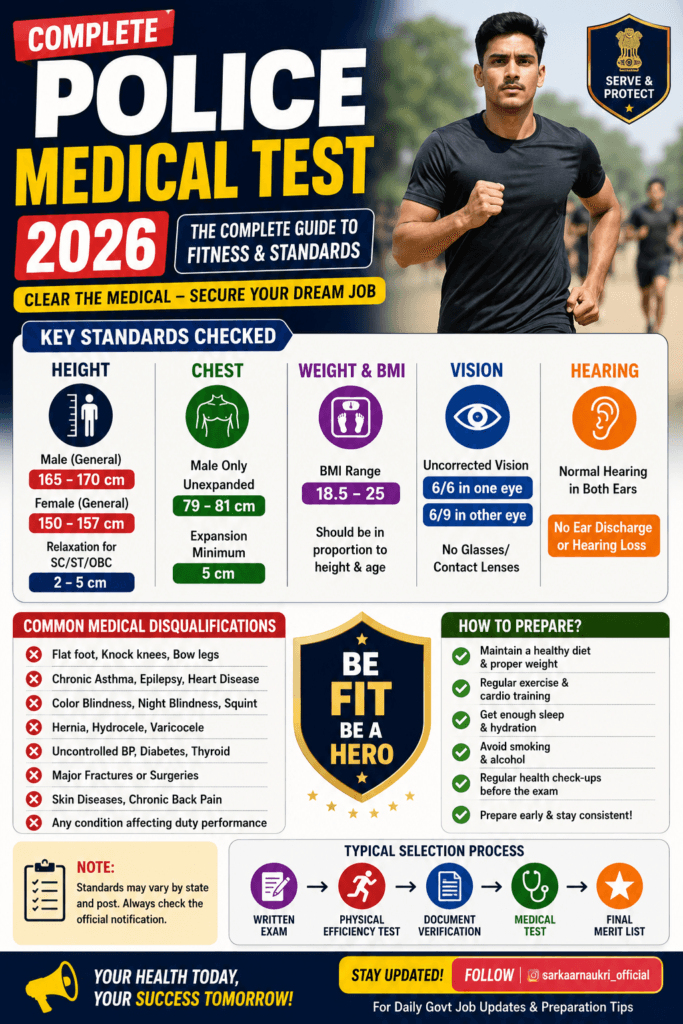
Every year, thousands of candidates clear the written exam and physical efficiency test for police recruitment, only to get disqualified at the police medical test stage over something they didn’t even know was a requirement. A police medical test isn’t just a routine health checkup, it’s a structured, multi-parameter examination covering height, chest measurement, weight, vision, hearing, and overall physical fitness, and even a minor issue like uncorrected vision or a healed fracture can end up costing a candidate their selection. This guide walks through exactly what the police medical test involves, how standards vary by state and post, and the mistakes that trip up otherwise well-prepared candidates. Whether you’re preparing for a constable-level post or an officer-rank recruitment, understanding the police medical test in detail before you appear for it can save you from an entirely avoidable rejection.
Why the Police Medical Test Matters
The police medical test exists because police work is physically demanding, often involving long duty hours, field postings, and situations that require sound physical and sensory capability. Unlike a general medical checkup, the police medical test is conducted by a medical board or designated civil surgeon appointed by the recruiting authority, and its findings are treated as final in most cases, with very limited scope for re-examination or appeal. Candidates are usually declared “medically fit” or “medically unfit,” and in most recruitment processes, being unfit at this stage results in disqualification regardless of how well the candidate performed in the written exam or physical efficiency test. This is why the police medical test is typically placed as one of the final stages of the selection process, after document verification, so that only candidates who have already cleared every other stage go through it.
Height and Chest Measurement Standards
Height and chest measurement form the most commonly checked physical parameters in a police medical test, and they vary significantly by state, category, and gender.
- General category male candidates: Most states require a minimum height between 165 cm and 170 cm, though some northeastern and hill states set slightly relaxed standards.
- General category female candidates: Minimum height requirements typically range from 150 cm to 157 cm depending on the state and post.
- SC/ST/OBC category relaxation: Nearly every state offers a height relaxation of 2 cm to 5 cm for SC/ST candidates, and many extend a smaller relaxation to OBC candidates as well.
- Chest measurement (male candidates only): Most recruitment boards require a minimum unexpanded chest of 79 cm to 81 cm, with a mandatory expansion of at least 5 cm on inhalation. Female candidates are generally exempt from chest measurement.
- State-specific variations: Hill states like Himachal Pradesh, Uttarakhand, and the northeastern states often set lower height and chest benchmarks compared to states like Uttar Pradesh, Bihar, or Rajasthan, recognizing regional physical differences in the local population.
It’s worth noting that height and chest standards are almost never relaxed for medical reasons; they’re fixed physical eligibility criteria checked at the very start of the police medical test, before the broader fitness examination begins.
Weight and Body Mass Requirements
Unlike height and chest, weight isn’t always an independently disqualifying factor in a police medical test, but it’s assessed in relation to height and overall body proportion.
- Most recruitment boards use a Body Mass Index (BMI) range, typically between 18.5 and 25, as a general fitness indicator rather than a hard weight cutoff.
- Being significantly underweight can be flagged as a sign of poor nutritional or physical fitness, while being overweight can affect the physical efficiency test scores and, in some cases, the medical fitness assessment itself.
- Some state police recruitments, particularly for specialized units like commando or armed battalions, do specify stricter weight-to-height ratios as part of the police medical test.
- Candidates preparing for recruitment should focus on being within a healthy, functional weight range well before the medical test date, since sudden weight loss or gain right before the exam can sometimes affect other test outcomes like blood pressure or endurance.
Vision and Eyesight Standards
Vision testing is one of the strictest components of the police medical test, and it catches a surprising number of candidates off guard.
- Uncorrected vision requirement: Most police recruitments require a minimum uncorrected vision of 6/6 in one eye and 6/9 in the other, meaning glasses or contact lenses generally cannot be used to meet the standard at the time of testing.
- Color blindness: Complete color blindness is disqualifying in almost every police recruitment, since color vision is considered essential for tasks like traffic duty, signal recognition, and reading uniforms or badges.
- Night blindness and squint: Both are typically treated as disqualifying conditions under the police medical test, since they affect a candidate’s ability to perform duties in low-light or high-alert situations.
- LASIK and corrective surgery: Many states now accept candidates who have undergone LASIK surgery, provided the surgery was completed a specified number of months before the test (commonly 6 to 12 months) and the resulting vision meets the uncorrected standard.
- Hearing standards: Candidates are also expected to have normal hearing in both ears, with no history of chronic ear discharge or significant hearing loss.
Common Medical Disqualification Reasons
Beyond height, chest, and vision, the police medical test screens for a range of conditions that can result in a candidate being declared unfit, even after clearing every earlier stage.
- Flat feet and knock knees: Both are commonly checked and can be disqualifying depending on severity and the specific recruitment board’s rules.
- Hernia and varicose veins: Untreated hernias and significant varicose veins are frequently flagged as disqualifying conditions in a police medical test.
- Old fractures and joint issues: A poorly healed fracture, restricted joint movement, or evidence of a previous major orthopedic injury can lead to rejection, even if the candidate feels fully recovered.
- Tattoos: Several states have specific rules restricting visible tattoos, particularly on the face, neck, or forearms, and candidates are sometimes asked to declare or cover tattoos during the police medical test.
- Piercing marks and skin conditions: Some recruitment boards also check for permanent ear piercing marks in male candidates or significant skin conditions that could affect uniform wear or field duty.
- Blood pressure and general health markers: Uncontrolled high blood pressure or signs of poor general health picked up during the examination can also result in a temporary or permanent unfit status.
State-wise Variations to Be Aware Of
Because police recruitment in India is largely conducted at the state level, the police medical test standards are not uniform across the country. Union Territory police forces and central paramilitary forces like the CRPF or BSF often follow their own separate medical standards, distinct from state police recruitment. States such as Rajasthan and Uttar Pradesh have historically maintained stricter height and chest benchmarks, while northeastern states and hill states tend to set comparatively relaxed physical standards, reflecting regional differences. Some states have also periodically revised their tattoo and cosmetic surgery rules in response to candidate representations, so it’s worth checking the specific recruitment notification rather than assuming standards from a previous cycle still apply. Given how much these details shift between recruitment cycles, checking the exact notification for your target state and post is far more reliable than relying on general assumptions.
Common Mistakes and Misconceptions
- Assuming glasses will be allowed: Many candidates wear glasses to the police medical test expecting the vision test to accommodate corrective lenses, only to be tested on uncorrected vision, which is the actual requirement in most recruitments.
- Ignoring minor old injuries: Candidates often assume a fully healed childhood fracture or a minor surgery years ago won’t matter, but the Medical Board can flag these during physical examination or X-ray, so it’s better to carry medical records proactively.
- Not preparing for chest expansion: Chest expansion of 5 cm is a specific, trainable measurement, and candidates who don’t practice deep breathing exercises or basic cardio conditioning sometimes fail to hit the expansion mark even if their base chest measurement is fine.
- Underestimating BMI checks: Crash dieting or sudden bulking right before the police medical test can throw off blood pressure readings and general fitness assessment, so gradual, consistent conditioning works better than last-minute changes.
- Not disclosing tattoos or piercings: Attempting to conceal a tattoo rather than checking the specific state’s rules on visibility and size can lead to complications during document and physical verification.
Practical Tips to Prepare for the Police Medical Test
- Get a general health checkup, including vision and blood pressure, at least two to three months before your expected medical test date, so there’s time to address any correctable issues.
- If you wear glasses regularly, start working with an eye specialist on whether LASIK is a viable and timely option, factoring in the required recovery period before your state’s minimum post-surgery window.
- Practice chest expansion exercises and general cardiovascular conditioning consistently in the weeks leading up to the test rather than attempting rapid changes right before it.
- Carry original medical records for any past fractures, surgeries, or ongoing treatments, since transparency with the Medical Board is generally viewed more favorably than being caught off guard during examination.
- Read the exact medical standards listed in your specific recruitment notification rather than relying on standards from a different state or a previous year’s cycle, since these details change more often than candidates expect.
Frequently Asked Questions
Q1. Can I wear glasses during the police medical test?
In most police recruitments, vision is tested without corrective lenses, so candidates are generally expected to meet the uncorrected vision standard rather than relying on glasses or contact lenses during the test.
Q2. Is LASIK surgery allowed before appearing for the police medical test?
Many states permit LASIK surgery, provided it was completed within a specified window before the test date, commonly 6 to 12 months, and the resulting uncorrected vision meets the required standard.
Q3. Do tattoos disqualify a candidate from the police medical test?
It depends on the state and the tattoo’s location and visibility. Several states restrict tattoos on the face, neck, or forearms while permitting smaller or coverable tattoos elsewhere on the body.
Q4. What happens if I fail the police medical test after clearing the written exam and PET?
Being declared medically unfit at this stage typically results in disqualification from that recruitment cycle, regardless of performance in earlier stages, since the medical test is usually one of the final stages before final selection.
Q5. Is there a height relaxation for SC, ST, and OBC candidates in the police medical test?
Yes, most states provide a height relaxation of 2 cm to 5 cm for SC/ST candidates, with a smaller relaxation often extended to OBC candidates as well, though the exact figures vary by state.
Q6. Can I request a re-examination if I disagree with the police medical test result?
Some recruitment boards allow a review or appeal to a Review Medical Board within a specified window, but this isn’t universal, and candidates should check their specific notification for the exact appeal process, if any.
Q7. Are weight standards the same across all police recruitments?
No, most recruitments assess weight relative to height through a general BMI range rather than a fixed weight cutoff, though some specialized units apply stricter weight-to-height standards.
Conclusion
The police medical test is a detailed, multi-parameter examination that can make or break a candidate’s selection even after they’ve cleared every other stage of the recruitment process. Understanding the height, chest, vision, and fitness standards well in advance, along with being aware of state-specific variations, gives candidates a real chance to prepare rather than being caught off guard. For candidates actively preparing for upcoming recruitments, checking the latest government job listings and Defence jobs alongside the specific medical standards for your target post is the most reliable way to stay ahead of this often-overlooked stage.
