Thousands of candidates clear the written police exam every year, only to be eliminated at the physical stage because they never trained for it seriously. If you are searching for a reliable police physical test guide, you have probably realized that written preparation alone will not get you into the force. This guide walks through every component of the physical selection process, from height and chest measurement to running, jumping, and endurance standards, so you know exactly what to expect and how to prepare for it.
Why a Police Physical Test Guide Matters
Police recruitment is one of the few government job categories where physical performance is treated as seriously as academic knowledge. A candidate can score well above the cutoff in the written paper and still be rejected within minutes at the Physical Standard Test if height or chest measurements fall short. This is exactly why every serious police physical test guide stresses preparation months in advance rather than a last minute scramble. Physical fitness cannot be built overnight, and recruiting boards rarely offer second attempts within the same recruitment cycle, so treating this stage casually is one of the costliest mistakes a candidate can make.
Understanding the Physical Standard Test
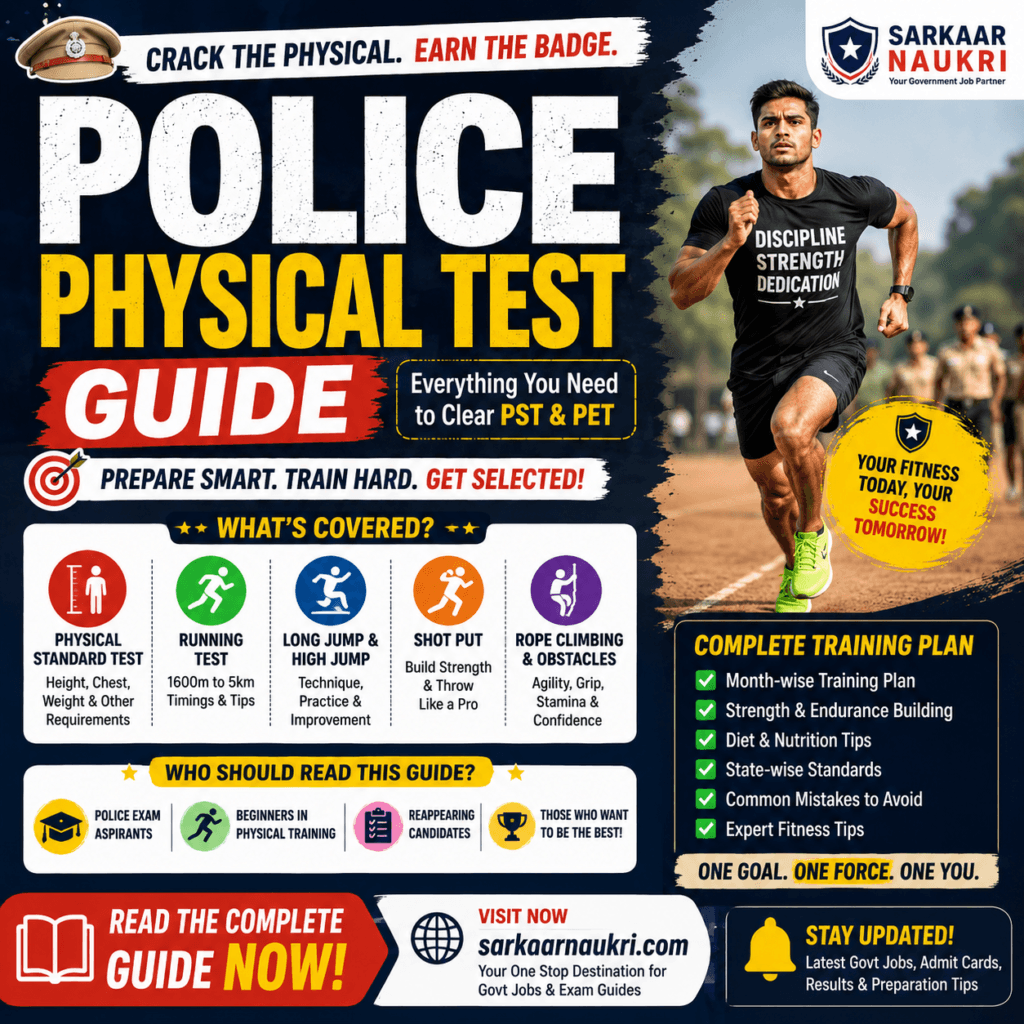
The Physical Standard Test, often called PST, checks whether a candidate meets the basic height, chest, and sometimes weight requirements set by the recruiting authority. Standards vary between states and between male and female candidates, and many boards also offer relaxation for Scheduled Caste, Scheduled Tribe, and other reserved categories. A dependable police physical test guide always recommends checking the official notification for exact figures, since a general estimate found online may not match the specific recruitment you are applying for. Common measurements checked at this stage include:
- Height (varies by state and gender, typically between 160 to 175 centimetres for men)
- Chest measurement including expansion (usually five centimetres minimum expansion required)
- Weight, in select recruitments where a minimum or proportional weight is specified
- Basic visual and physical fitness screening before candidates proceed to the endurance round
Understanding the Physical Efficiency Test
Once a candidate clears the Physical Standard Test, the Physical Efficiency Test, or PET, evaluates actual fitness through timed events. This is the stage where most candidates who ignored training during their preparation phase struggle the most. A well-rounded police physical test guide should always cover these commonly tested events in detail:
Running
Most recruitments require candidates to complete a race, usually between 1600 meters and 5 kilometers depending on the post and gender, within a fixed qualifying time. Running is the single most decisive event in many recruitments because timing is measured precisely and there is no partial credit for a slow finish, which is why every Police Physical Test Guide places heavy emphasis on running practice above almost everything else.
Long Jump and High Jump
Several state police recruitments include a standing or running long jump, along with a high jump requirement in some cases. These events test explosive leg strength and require dedicated practice sessions separate from regular running training, and any thorough Police Physical Test Guide should treat them as a distinct training block rather than an afterthought.
Shot Put
Shot put, when included, tests upper body and core strength. Candidates who focus only on cardio during preparation often underperform here, which is why a balanced Police Physical Test Guide always recommends combining strength training with endurance work, since a strong Police Physical Test Guide never treats fitness as one dimensional.
Rope Climbing or Obstacle Events
Some forces, particularly for constable and head constable posts, include rope climbing or short obstacle courses that test agility and upper body strength together.
Building a Training Plan Months in Advance
A realistic police physical test guide should never suggest cramming physical preparation into the final few weeks before the exam. Ideally, candidates should begin structured training at least four to six months before the expected test date. Following a consistent police physical test guide over several months, rather than switching routines every few weeks, tends to produce far more reliable results. A workable weekly plan mixes running days with strength training days, gradually increasing distance and intensity while tracking timing against the official qualifying standard for the target post. Nutrition and recovery matter just as much as the training itself, since injuries from overtraining are one of the most common reasons candidates fail to appear for their physical test at all.
State-Wise Variations in Physical Standards
Physical standards are not uniform across India, and this is one of the most overlooked parts of physical preparation. Some states set higher height requirements for general category candidates while offering meaningful relaxation for reserved categories, ex servicemen, and residents of specific regions such as hill areas. Running distances, qualifying timings, and even the number of chances given per event can differ between a state police recruitment and a central force recruitment such as CAPF or Delhi Police. Before finalizing your training routine, always cross check the exact standards from the official notification of the post you are targeting, since assuming a generic standard is one of the most common errors candidates make (see our detailed Age Relaxation Rules guide for category wise breakdowns). For SSC administered posts such as Delhi Police and CAPF, the official SSC website publishes the exact physical standards along with the recruitment notification, while individual state police boards typically publish their own PST and PET criteria on their official recruitment portals.
Common Mistakes Candidates Make During Physical Preparation
Every experienced Police Physical Test Guide highlights a recurring set of avoidable errors that quietly cost candidates their selection. Watch out for these specific patterns:
- Starting physical training only after the written exam result is announced, leaving too little time
- Focusing only on running while neglecting strength events such as shot put or long jump
- Not practicing the exact event format, such as a standing start versus a running start for long jump
- Ignoring proper warm up and stretching routines, which increases injury risk during training
- Skipping nutrition planning, leading to fatigue during longer training sessions
- Assuming physical standards from a previous recruitment cycle still apply without checking the current notification
- Training alone without any way to accurately time or measure performance against official standards
Practical Tips to Clear the Physical Test
The following tips summarize what every practical Police Physical Test Guide should emphasize once the basics of training are already in place:
- Get a basic medical checkup before starting intense training, especially if you have had prior injuries
- Track your running time and distance weekly so you can measure real progress against the qualifying standard
- Practice the specific technique for jump and throw events rather than relying on general fitness alone
- Simulate exam day conditions occasionally, including the same time of day and similar clothing or footwear
- Prioritize sleep and hydration in the final two weeks before the test rather than pushing for last minute gains
- Carry all required documents and reach the test venue early to avoid last minute stress affecting performance
Frequently Asked Questions
What is included in a typical Police Physical Test Guide? A complete Police Physical Test Guide usually covers height and chest standards for the Physical Standard Test, along with running, jumping, and throwing events for the Physical Efficiency Test, plus category wise relaxation rules.
How many months before the exam should physical training start? Most successful candidates begin structured training four to six months before the expected test date, since sudden intense training in the final weeks often leads to injury rather than improvement.
Do women candidates have different physical standards than men? Yes, height, chest, and running timing standards are almost always lower for women compared to men, and the exact figures vary by recruiting authority and state.
Is there relaxation in physical standards for reserved categories? Many states and central forces offer height and chest relaxation for Scheduled Caste, Scheduled Tribe, and certain other categories, though the exact relaxation varies significantly between recruiting bodies.
Can a candidate retake the physical test if they fail on the first attempt? Most recruitments do not allow a retake within the same cycle, which is why thorough preparation before appearing for the test matters far more than hoping for a second chance.
What happens if a candidate is fit but slightly short on height standards? Height is usually treated as a fixed eligibility requirement rather than a scored event, so falling short even slightly typically results in disqualification regardless of overall fitness.
How important is diet during physical test preparation? Diet plays a major role in recovery and sustained energy during training, and any complete Police Physical Test Guide will note that neglecting nutrition often shows up as fatigue or slower improvement despite consistent training effort.
Are physical test standards the same for constable and sub inspector posts? No, standards frequently differ between constable and sub inspector recruitments even within the same state, so any accurate Police Physical Test Guide will always tell candidates to check the specific notification for their target post rather than assuming standards carry over.
Conclusion
A dependable police physical test guide should leave you with a clear picture of exactly what standards you need to meet and how to train for them systematically rather than randomly. Candidates who start early, track their progress, and respect both strength and endurance training tend to clear this stage far more consistently than those who treat it as an afterthought. For related preparation guidance, check our articles on SI Exam Preparation and Government Job Exam Preparation Tips to build a complete study and training plan.
