Introduction
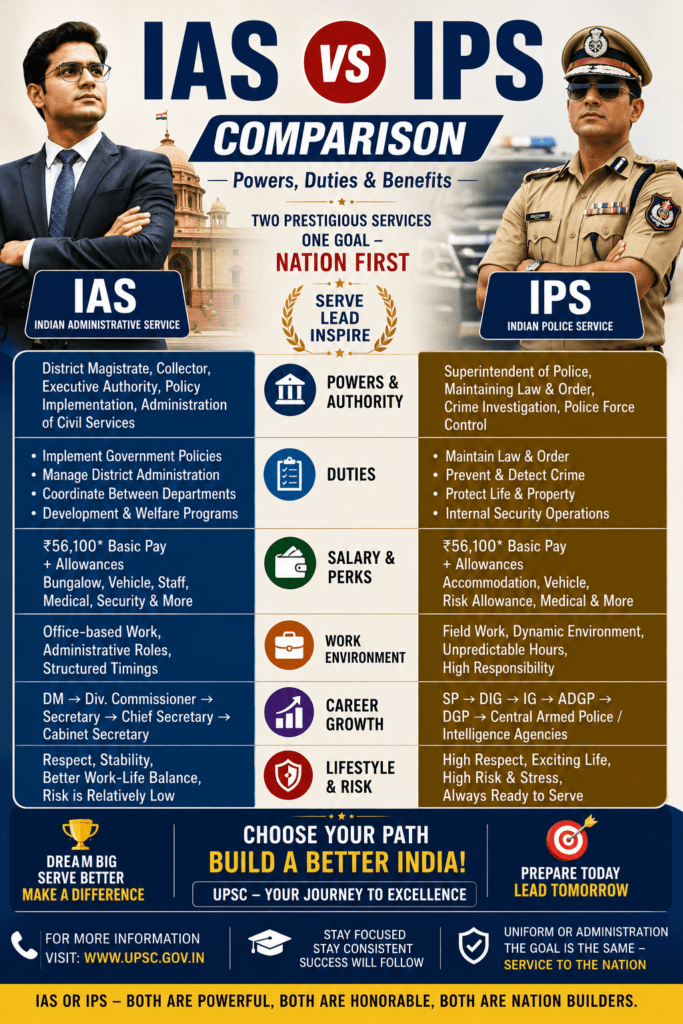
IAS vs IPS Comparison is one of the most important topics for UPSC aspirants preparing for India’s civil services examination. The Indian Administrative Service (IAS) and the Indian Police Service (IPS) are among the most prestigious and respected government careers in the country. Both services provide high authority, excellent salaries, social respect, and opportunities to serve the nation.
However, there are major differences between IAS and IPS in terms of:
- powers,
- duties,
- work environment,
- career growth,
- stress level,
- and lifestyle.
Many aspirants remain confused while choosing between IAS and IPS after clearing the UPSC Civil Services Examination. Some candidates prefer administrative leadership through IAS, while others are attracted to the uniformed service and policing responsibilities of IPS officers.
This detailed IAS vs IPS Comparison guide explains every major difference between these two elite civil services including salary, powers, responsibilities, promotions, work-life balance, and benefits.
What Is IAS?
The Indian Administrative Service is India’s top administrative civil service.
IAS officers are responsible for:
- administration,
- governance,
- policy implementation,
- district management,
- and public welfare programs.
Official UPSC Website:
UPSC Official Website
IAS officers work at:
- district level,
- state level,
- and central government level.
What Is IPS?
The Indian Police Service is India’s premier police and internal security service.
IPS officers handle:
- law and order,
- crime control,
- anti-terror operations,
- intelligence activities,
- and police administration.
IPS officers lead police departments and security forces across India.
IAS vs IPS Comparison – Powers
One of the most searched aspects in IAS vs IPS Comparison is authority and power.
IAS Officer Powers
IAS officers hold wider administrative powers.
Major IAS Powers
- District administration
- Revenue management
- Policy implementation
- Coordination between departments
- Disaster management supervision
- Election administration
A District Magistrate (DM) or Collector often supervises overall district administration.
IAS officers also coordinate with police departments and multiple government agencies.
IPS Officer Powers
IPS officers hold strong law enforcement powers.
Major IPS Powers
- Maintaining law and order
- Criminal investigation
- Managing police forces
- Anti-terror operations
- Traffic administration
- Intelligence operations
An IPS officer serving as Superintendent of Police (SP) controls district police operations and security systems.
In policing matters, IPS officers hold major operational authority.
IAS vs IPS Comparison – Duties
IAS Officer Duties
IAS officers focus on:
- governance,
- administration,
- policy execution,
- and development work.
Common IAS Responsibilities
- Implementing government schemes
- Managing district administration
- Monitoring welfare programs
- Revenue collection
- Handling public grievances
IAS officers play a direct role in public administration and policy execution.
IPS Officer Duties
IPS officers mainly focus on:
- public safety,
- criminal law enforcement,
- and internal security.
Common IPS Responsibilities
- Crime prevention
- Police administration
- Riot control
- Investigation supervision
- VIP security
- Anti-corruption operations
IPS officers frequently work in high-pressure field environments.
IAS vs IPS Comparison – Salary
Salary is another major factor in IAS vs IPS Comparison.
IAS Salary
Starting basic salary:
- ₹56,100 per month
Additional IAS benefits:
- Government bungalow
- Official vehicle
- Domestic staff
- Security personnel
- Medical facilities
- Travel allowances
Senior IAS officers receive very high salaries and benefits.
IPS Salary
IPS officers also receive:
- ₹56,100 starting basic salary,
- along with additional allowances.
Additional IPS benefits include:
- Risk allowance
- Police accommodation
- Official vehicle
- Security cover
- Medical benefits
Under the 7th Pay Commission, IAS and IPS salary structures are mostly similar.
IAS vs IPS Comparison – Lifestyle
Lifestyle differences are important in IAS vs IPS Comparison.
IAS Lifestyle
IAS officers generally have:
- office-based administrative work,
- structured routines,
- and comparatively stable schedules.
Although administrative pressure is high, work conditions are relatively balanced.
IPS Lifestyle
IPS officers experience:
- physically demanding schedules,
- emergency duties,
- criminal investigations,
- and unpredictable work hours.
IPS life is more dynamic and action-oriented.
IAS vs IPS Comparison – Work Pressure
IAS Work Pressure
IAS officers face:
- administrative responsibilities,
- political pressure,
- public accountability,
- and policy implementation challenges.
They make critical decisions affecting governance and public welfare.
IPS Work Pressure
IPS officers handle:
- law and order crises,
- criminal threats,
- riots,
- terrorism,
- and emergency security situations.
Operational stress is generally higher in IPS service.
IAS vs IPS Comparison – Promotion
IAS Promotion Hierarchy
IAS officers may rise to:
- District Magistrate
- Divisional Commissioner
- Principal Secretary
- Chief Secretary
- Cabinet Secretary
The Cabinet Secretary is India’s highest bureaucratic position.
IPS Promotion Hierarchy
IPS officers may rise to:
- SP
- DIG
- IG
- ADGP
- DGP
IPS officers can also work in:
- CBI,
- RAW,
- IB,
- NIA,
- CRPF,
- BSF,
- and CISF.
IAS vs IPS Comparison – Social Respect
Both IAS and IPS officers enjoy massive respect in Indian society.
IAS Respect
IAS officers are viewed as:
- top administrators,
- policymakers,
- and senior government executives.
IPS Respect
IPS officers command public respect because of:
- police leadership,
- uniform authority,
- and crime-control responsibilities.
The IPS uniform itself carries strong prestige.
IAS vs IPS Comparison – Risk Factor
IAS Risk Level
IAS officers mainly face:
- administrative pressure,
- political controversies,
- and governance-related stress.
Physical danger is relatively lower.
IPS Risk Level
IPS officers may face:
- armed criminals,
- mob violence,
- terrorism,
- and encounter situations.
IPS careers involve significantly higher field risk.
IAS vs IPS Comparison – Work-Life Balance
IAS Work-Life Balance
IAS officers may maintain:
- relatively stable schedules,
- family time,
- and structured administrative work.
District postings can still remain highly demanding.
IPS Work-Life Balance
IPS officers often deal with:
- emergency duties,
- night operations,
- sudden law and order situations,
- and irregular schedules.
Work-life balance is generally more challenging in IPS service.
IAS vs IPS Comparison – Training
IAS Training Academy
IAS officers train at:
- Lal Bahadur Shastri National Academy of Administration (LBSNAA), Mussoorie.
Official Website:
LBSNAA Mussoorie
Training focuses on:
- administration,
- governance,
- economics,
- law,
- and public policy.
IPS Training Academy
IPS officers train at:
- Sardar Vallabhbhai Patel National Police Academy (SVPNPA), Hyderabad.
Official Website:
SVPNPA Hyderabad
IPS training includes:
- physical training,
- weapons handling,
- investigation techniques,
- and tactical operations.
IAS vs IPS Comparison – Which Has More Power?
One of the biggest debates in IAS vs IPS Comparison is regarding authority.
IAS Officers Have Wider Administrative Authority
IAS officers coordinate:
- departments,
- development programs,
- district administration,
- and policy execution.
The District Magistrate usually supervises overall district governance.
IPS Officers Have Strong Police Authority
IPS officers independently control:
- police operations,
- criminal investigations,
- and security management.
In policing matters, IPS officers have significant operational power.
Which Service Should You Choose?
Choose IAS If You:
- enjoy administration,
- want policymaking authority,
- prefer governance roles,
- and seek broader executive power.
Choose IPS If You:
- enjoy action-oriented careers,
- like policing and security work,
- prefer field leadership,
- and admire uniform service prestige.
Internal Link Example:
Read Also:
UPSC vs SSC Which is Better for Government Job Aspirants
Advantages of IAS
Key IAS Benefits
- High administrative authority
- Policy-level influence
- Stable career growth
- Prestigious leadership roles
- Broader governance exposure
Advantages of IPS
Key IPS Benefits
- Uniform prestige
- Police leadership authority
- Exciting fieldwork
- Strong public influence
- National security opportunities
Conclusion
This IAS vs IPS Comparison clearly shows that both services offer prestigious careers, high salaries, social respect, and opportunities to serve India. However, the nature of work differs significantly.
IAS officers focus on:
- administration,
- governance,
- and policymaking.
IPS officers focus on:
- law enforcement,
- public safety,
- and security operations.
The choice between IAS and IPS depends on:
- personality,
- career interests,
- lifestyle preference,
- and long-term goals.
Candidates interested in governance and administrative leadership may prefer IAS, while those passionate about policing, security, and action-oriented work may choose IPS.
Both services remain among the most respected careers in India and provide outstanding opportunities for nation-building and public service.
